
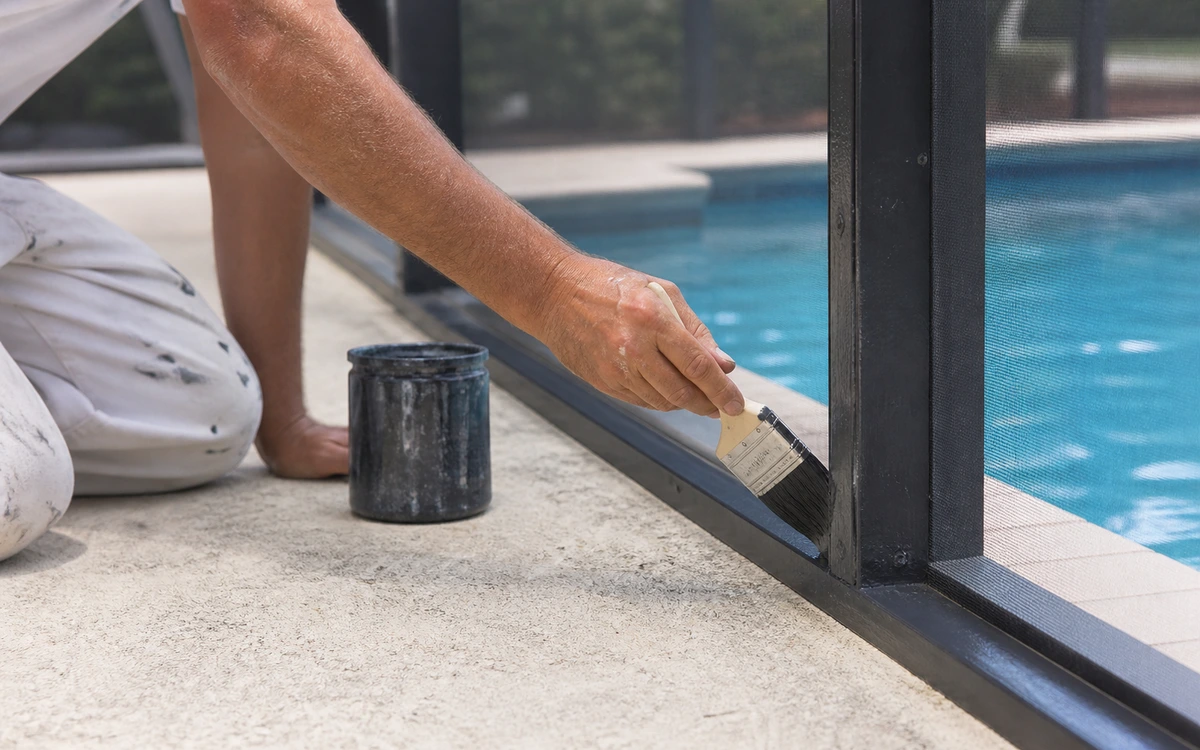
We provide professional pool cage painting services in Grand Rapids, MI for faded, chalking, and corroded aluminum enclosures affected by constant sun, salt air, and weather exposure. Coatings restore protective finish to aluminum framing, sealing oxidation and UV damage while creating a durable barrier that prevents corrosion and surface breakdown. Request a quote today.
Why Does Pool Cage Paint Peel, Fade, or Turn Chalky Over Time?
Pool cage paint peels or turns chalky because UV exposure and moisture slowly break down the protective coating. Aluminum frames expand and contract daily, which weakens adhesion and exposes the surface layer. Once the oxidation starts, the finish loses its bond and begins flaking.
How do Lake Michigan weather systems and inland humidity affect pool cage painting in Grand Rapids?
In Grand Rapids, lake-influenced weather patterns combined with seasonal humidity can wear down exterior coatings. Neighborhoods near the Grand River, Eastown, and surrounding Kent County areas often see paint cracking and rust forming on screened enclosures. Pool cage repainting helps protect against freeze-thaw cycles and moisture exposure.
Can You Repaint a Pool Cage Without Replacing the Structure or Screen?
Yes, a pool cage can be repainted without replacing the structure or screening if the frame is still structurally sound. The key is ensuring the aluminum and fasteners are not heavily corroded or failing. A properly prepped surface allows new coating to bond directly to the existing frame.
How Long Does a Properly Painted Pool Cage Usually Last in Harsh Sun Conditions?
A properly painted pool cage typically lasts many years under strong sun exposure when high-quality coatings are used. UV rays are the main factor that slowly degrade the protective layer over time. Salt air, humidity, and poor prep work can significantly shorten that lifespan.
What Is the Difference Between Repainting a Pool Cage and Powder Coating It?
Repainting a pool cage uses liquid coatings applied on-site, while powder coating is a baked factory finish applied in controlled conditions. Powder coating generally creates a harder, more uniform surface, but it requires full disassembly. Repainting is more practical for existing structures that are already installed.
Why Is Surface Preparation Critical Before Painting a Pool Cage?
Surface preparation is critical because paint will not bond properly to oxidized or contaminated aluminum. Dirt, oxidation, and old coatings must be fully removed so the new finish can adhere evenly. Without proper prep, peeling and bubbling usually start within a short period.
What Are the Most Common Reasons Pool Cage Paint Jobs Fail Early?
Pool cage paint jobs fail early mainly due to poor surface prep, low-quality coatings, or moisture trapped during application. Aluminum oxidation that isn’t fully removed also prevents proper adhesion. Environmental exposure like constant sun and humidity accelerates these failures.
How Much Does Pool Cage Painting Cost in Grand Rapids, MI?
Pool Cage Painting costs in Grand Rapids, MI typically range between $1,710 and $6,412, with estimated pricing depending on the overall size of the enclosure, the height and layout of the structure, and the condition of the aluminum framing including existing paint wear or corrosion. Pricing can also vary based on secondary complexity factors such as the amount of surface prep required, masking and protection of screening materials, rust treatment needs, and access constraints around the pool area.